OnlyFans Management Contract scams: What to Know Before You Sign
August 16, 2026 · 8 min read · By Exclu Team
An OnlyFans management contract is a legally binding agreement between you and an agency. Before signing, you need to verify that it protects your content ownership, defines a fair commission on net revenue, includes a short exit clause (30–60 days notice), and doesn't auto-renew without your consent. Any contract that's vague, rushed, or locks you in for 12+ months with exit fees deserves serious scrutiny - or a hard pass.
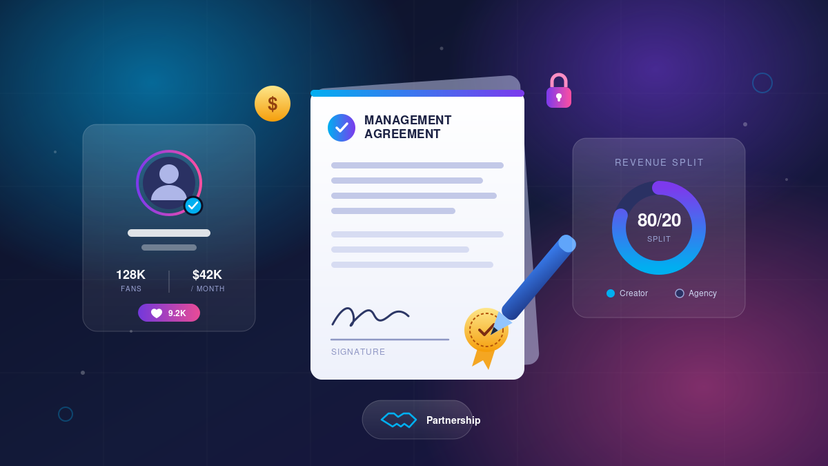 What Is an OnlyFans Management Contract?
An OnlyFans management contract is the formal agreement that defines the working relationship between a creator and an agency.
It covers what the agency will do for you, how much they'll take, who owns your content, and - critically - how you get out if things don't work.
Think of it as the rulebook for the relationship. If the agency verbally promises you growth, DM management, and weekly strategy calls but none of that is in the contract, you have no legal ground to stand on if they don't deliver.
A solid OnlyFans manager agreement protects both sides. But in practice, most contracts are written by the agency - for the agency. Your job is to read it like it might be used against you. Because it might be. On the agency side, our guide on how to become an OnlyFans manager walks through the same steps from the other direction.
What Should Be in a Legitimate Contract (Checklist)
A well-written OnlyFans agency contract covers these eight areas without ambiguity:
1. Parties and identities
Full legal names of both the creator and the agency
Business entity names, trade names, OnlyFans usernames
Signature blocks with dates
2. Scope of services
Exactly what the agency handles: DM management, posting, marketing, analytics, social media promotion
Frequency of delivery (e.g., daily DM responses, weekly performance reports)
What is not included - so there are no surprises later
3. Creator deliverables
How much content you're expected to produce per week or month
Minimum video lengths or format requirements
Turnaround times
4. Compensation and payment terms
Commission percentage (and whether it's on gross or net revenue - this matters enormously)
Payment schedule and method
Any additional fees for extra services
5. Content ownership and IP rights
You own your content. Full stop.
The agency may only use your content for promotional purposes, with clear limits
No "irrevocable" or "perpetual" license language
6. Account access and control
Who has login access and how (official platform tools only, not your personal password)
What happens to access on termination
7. Confidentiality
Your earnings, personal data, and account details stay private
No sharing with third parties without your written consent
8. Term and termination
Start date, contract length, notice period to exit
What happens to your content, account, and pending payments after you leave
No automatic renewal without mutual agreement
If any of these eight sections is missing or vague, ask for it in writing before you sign. A legitimate agency won't hesitate.
Always use Exclu as a backup accounts, in the event something happen:
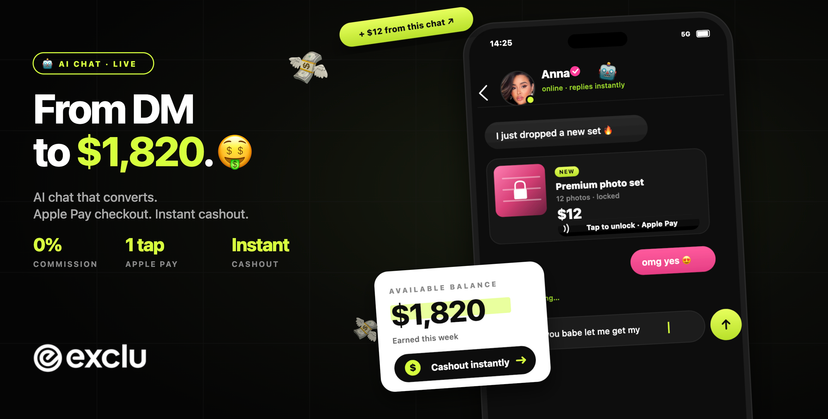
To make transactions safer and more professional for both creators and fans, many agencies and creators are now using Exclu alongside their existing platforms. Exclu provides a secure payment environment where fans can purchase exclusive content, custom requests, and private experiences without relying on risky direct payments. By keeping payments and deliveries organized in one place, creators can reduce disputes, improve trust, and offer a smoother buying experience for their audience.
Red Flags in OnlyFans Agency Contracts
These are the clauses that trap creators. Don't skip this section.
🚩 Guaranteed income promises "We'll get you to $10K/month" in a contract is a red flag, not a selling point. No agency can guarantee earnings. If it's written in, ask how it's enforced - and watch them squirm.
🚩 Pressure to sign immediately Any agency that says "this offer expires tonight" is using a sales tactic, not running a professional operation. Take at least 48–72 hours to review any contract.
🚩 Content ownership or "work for hire" language Watch for phrases like "irrevocable license," "perpetual rights," or "work product created in connection with services." These can give the agency lasting rights to your content - even after you leave. Reject this language entirely.
🚩 Long lock-in periods with exit penalties A 12–24 month contract with a buyout fee calculated on "projected earnings" is a financial trap. If the agency underperforms, you're still stuck - or you pay to leave. Fair contracts run 3–6 months with a 30–60 day notice period.
🚩 Automatic renewal clauses Some contracts renew automatically unless you cancel within a 15–30 day window before the end date. Miss the window by a week and you're locked in for another full term. Agencies rarely remind you. Always calendar the deadline the day you sign.
🚩 Commission on gross revenue If the agency takes 30% of your gross earnings before platform fees are deducted, that's a much bigger cut than it sounds. Always negotiate commission on net revenue.
🚩 Vague service descriptions "Agency will provide management services as mutually agreed" means nothing. If the contract doesn't name specific services, you have no legal basis to exit if they underperform.
🚩 Password requests Legitimate agencies use official OnlyFans team account features. If they ask for your personal login credentials, that's a security and control risk - not standard practice.
🚩 All legal liability on you Broad indemnity clauses that make you responsible for any claim arising from the agency's marketing or financial decisions are unfair. If they're running your account, they share the liability.
Common Contract Terms Explained
OnlyFans agency terms can read like legal jargon. Here's what the key phrases actually mean:
Gross revenue vs. net revenue Gross is your total earnings before any deductions. Net is what's left after platform fees (OnlyFans takes 20%). A 30% commission on gross is effectively ~37% of your actual take-home. Always push for net.
Exclusivity clause Means you can't work with another agency (or sometimes any other platform) during the contract. Understand the exact scope - some exclusivity clauses are reasonable; others block you from managing your own account independently.
Indemnification You agree to cover the agency's legal costs if a third party sues over something related to your content or account. Fair contracts make this mutual, not one-sided.
Liquidated damages A pre-set penalty you owe if you exit early. This is the "exit fee" - and it's often calculated on projected, not actual, earnings. That calculation can be enormous. Push to remove it or cap it at a fixed, reasonable amount.
Non-compete clause Prohibits you from working with other agencies (or sometimes operating independently) for a set period after leaving. These are increasingly hard to enforce in many U.S. states, but fighting one still costs time and legal fees. Better to not sign one at all.
Governing law / arbitration clause Specifies which country or state's laws apply and where disputes are resolved. If the agency is in a different jurisdiction, this can make it practically impossible for you to enforce your rights without expensive travel or remote legal filings.
How to Negotiate Your Contract
You have more leverage than you think - especially before you sign.
Start with the non-negotiables:
You retain full ownership of all content, during and after the contract
Commission is calculated on net revenue, not gross
Exit notice is 30–60 days maximum, with no buyout fee
No automatic renewal - explicit mutual agreement required
No non-compete clause
Then push on the details:
Ask for a specific list of services with delivery frequency
Request monthly financial reports with full revenue and deduction breakdowns
Add a performance exit clause: if agreed benchmarks aren't hit within 60–90 days, you can leave without penalty
Limit any promotional use of your content to the duration of the contract only
Practical tips:
Get every verbal promise in writing, as an amendment to the contract if needed
Use a lawyer who specializes in creator contracts or entertainment law - a one-hour consultation ($150–$300) is worth it before signing a 12-month deal
If an agency refuses to negotiate any clause, that tells you everything about how they'll treat you once you're signed
A confident agency with real results doesn't need restrictive terms to keep you. Their performance is the retention mechanism.
What Happens If You Want to Leave the Agency?
This is the section most creators don't read until it's too late.
If your contract has a clean exit clause: You give the required notice (ideally 30 days), the agency returns full account access, content rights revert to you immediately, and any pending earnings are paid out on the normal schedule. Clean and simple.
If your contract has a messy exit clause: You may face a buyout fee, a non-compete that limits what you can do next, a dispute over content rights, or an agency that simply refuses to hand back account access. These situations can take weeks or months to resolve - sometimes with legal help.
Before you try to exit, check:
The exact notice period and how notice must be delivered (email? Certified mail? Specific form?)
Whether any exit fee applies and how it's calculated
What the contract says about account access on termination
Whether a non-compete restricts your next steps
If you're already in a bad contract:
Document everything - all communications, promises made, and services not delivered
Consult a lawyer before sending any termination notice
Check whether the agency has breached any of their own obligations (missed deliverables, no reports, no access) - a material breach by them may give you grounds to exit without penalty
The best time to think about leaving is before you sign. The second-best time is now.
FAQ
What is a fair commission rate in an OnlyFans management contract?
Industry rates for full-service management typically sit between 30–40% of net revenue for new creators. Anything above 50% - especially on gross revenue - is excessive. Anything below 20% for full-service management is worth scrutinizing too; it may signal hidden fees or underdelivery on services.
Do I need a lawyer to review an OnlyFans agency contract?
Not always, but it's strongly recommended for contracts longer than 3 months or with complex termination clauses. A one-hour consultation with an entertainment or contract lawyer typically costs $150–$300 and can save you from a much more expensive mistake.
Can an OnlyFans agency own my content?
Only if you sign a contract that says so. No agency should own your content. A legitimate OnlyFans contract template will state clearly that the creator retains all intellectual property rights, and the agency only has a limited, time-bound right to use content for promotional purposes.
What should a fair exit clause look like?
A 30–60 day written notice period, no buyout fee (or a small, fixed administrative fee), immediate reversion of account access and content rights, and payment of any outstanding earnings within the normal payment cycle. No auto-renewal. No non-compete.
What if an agency asks for my OnlyFans password?
Don't give it. Legitimate agencies use OnlyFans' official team account features to access your account without needing your personal credentials. Handing over your password gives them full control - including the ability to lock you out.